

Indonesia holds one of the world’s largest carbon credit potentials, supported by its vast natural resources. To strengthen its carbon market ecosystem, the Indonesian government continues to develop a transparent, reliable, and efficient carbon trading system that can attract broader participation from both domestic and international market players.
As part of this effort, the government issued Minister of Forestry Regulation No. 6 of 2026 on Procedures for Carbon Trading Through Greenhouse Gas Emission Offsets in the Forestry Sector (“MOFR 6/2026”) as an implementing regulation of Presidential Regulation No. 110 of 2025. The regulation replaces Minister of Environment and Forestry Regulation No. 7 of 2023 (“MOEF 7/2023”) to accommodate evolving legal and market needs and designates the Minister of Forestry (“Minister”) as the main authority overseeing carbon trading activities in the forestry sector. We set out below some of the new highlights under MOFR 6/2026.
It is important to highlight that MOFR 6/2025 applies exclusively to forestry sector, namely carbon generated from climate change mitigation actions carried out in production forest areas, utilization blocks/zones of protection forests and conservation areas, customary forests (hutan adat), private forests (hutan hak), and certain state forests. Carbon trading in other sectors covered by Indonesia’s NDC, such as energy, waste, industrial processes and product use, and agriculture, falls outside this regulation and remains governed by the respective sectoral implementing regulations under PR 110/2025.
International Carbon Units are Welcome
By definition of carbon trading, it is well established that business actors may engage in carbon trading only if they hold carbon units. MOFR 6/2026 specifies that these carbon units may take the form of:
- Greenhouse Gas Emission Reduction Certificate (Sertifikat Pengurangan Emisi Gas Rumah Kaca – “SPE-GRK”), issued by the Minister, based on ministerial recommendation; or
- non-SPE-GRK, issued by international standards, based on ministerial approval.
Under the superseded regulation (i.e., MOEF 7/2023), the government prioritized domestic carbon units (i.e., SPE-GRK). Foreign-issued units had to pass through a reciprocal recognition process before they could receive equivalent treatment. By expressly recognizing non-SPE-GRK units, MOFR 6/2026 provides business actors with a clearer and more direct pathway to access global buyers that prefer internationally recognized carbon standards.
To support coordination with international certification bodies, the Minister may issue an approval letter for non-SPE-GRK schemes that remains valid for six months. This time period provides greater administrative certainty for project developers and market participants.
International Carbon Trading: Limitation on Exports of Carbon Units
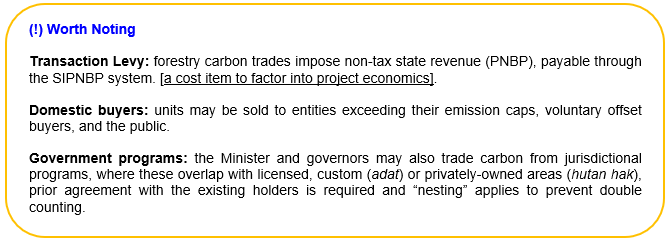
MOFR 6/2026 expressly allows business actors holding carbon units (in a form of SPE-GRK or non-SPE-GRK) to conduct international carbon trading. However, they must first apply to the Minister for a recommendation to obtain authorization and corresponding adjustment to be authorized by the Minister of Environment.
Despite opening access to international markets, align with the superseded regulation, the government still maintains certain control over exports of carbon units. The Minister may assess whether the transfer of carbon units could affect Indonesia’s nationally determined contribution (NDC) targets. If the units are needed to support national climate commitments, the Minister may refuse to recommend their export. This reflects the concerns that excessive carbon credit sales could encourage international greenwashing without increasing global climate ambition.
Compliance Beyond Licensing: What Business Actors Must Do Now
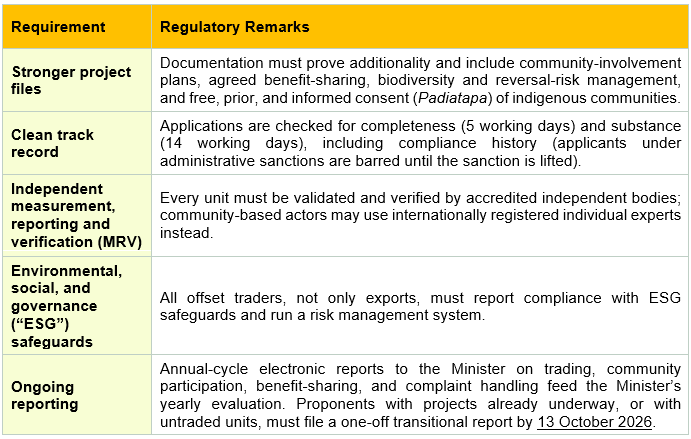
Under MOEF 7/2023, holding a forestry license was essentially the way to carbon trading. Now, MOFR 6/2026 opens the door wider. Social forestry approval holders, custom (adat) communities, registered private forests (hutan hak) holders, and carbon environmental services utilization business license holder may now all participate, but the bar is higher.
Conclusion
Overall, MOFR 6/2026 positions international carbon trading as a regulated public policy instrument rather than a fully open market. The regulation aims to balance international market access, national climate commitments, and environmental protection. Business actors seeking to enter international carbon markets must therefore adopt strong compliance strategies, including validation and verification by internationally accredited independent institutions. Existing business actors must report their activities within six months after the issuance of MOFR 6/2026 to align with the new procedures.
-----
Click the "download file" button to read the PDF version.
If you have any questions, please contact
- Frederick Simanjuntak, Partner - frederick.simanjuntak@makarim.com
- Anastasia Anggita, Senior Associate - anastasia.anggita@makarim.com
- Lovelyn Tayuwijaya, Associate - lovelyn.tayuwijaya@makarim.com
M&T Advisory is a digital publication prepared by the Indonesian law firm, Makarim & Taira S. It informs generally on the topics covered and should not be treated as legal advice or relied upon when making investment or business decisions. Should you have any questions on any matter contained in M&T Advisory, or other comments in general, please contact us at the emails provided at the end of this article.